
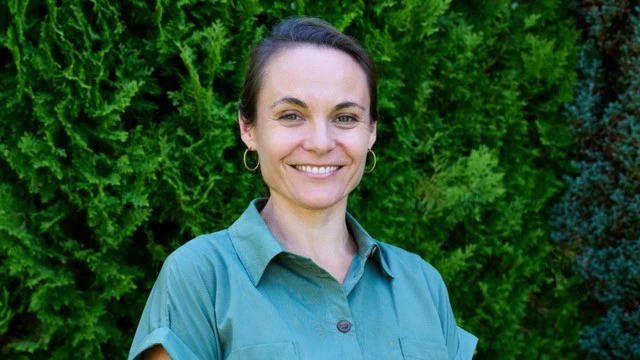
Meet Recovery Counsellor Neus Cortes
Neus Cortes is comfortable not knowing exactly what will happen next. When she creates art, she rarely begins with a fixed idea of where it will end. She lets the work develop, sometimes surprising herself with what appears.
“It evolves. It just comes naturally,” she says of her artwork. There is a particular pleasure in looking at something that has seemingly appeared from nowhere, through her own hands, and thinking: “Wow.”
There is an openness in her approach that extends beyond her art. Neus has lived in different countries, sought out new cultures and experiences. In her work as a recovery counsellor, she is equally comfortable allowing a conversation to develop rather than forcing it in a predetermined direction. It is part of what makes her approach at NEOVIVA distinctive.
Neus is interested in words, of course. She listens carefully, and people tend to naturally confide in her. But she is also interested in what happens when words are difficult to find: what someone feels in their body, what they might express through movement, an image, music, or even silence.
For Neus, there are times when words are not enough. “That can matter in treatment. Someone may feel angry, afraid, overwhelmed or simply not okay without yet being able to explain what is happening.”
Finding other ways to express what we feel
Creativity has always been a big part of Neus’s life.
She grew up in a small Mediterranean town on the coast of Alicante, Spain, in a family where making things was normal. Her parents worked with sculpture, and her sister makes jewellery. Neus went on to study art and education, eventually completing a master’s degree in the subject.
Her life has also taken her well beyond Spain. She studied in Hamburg, lived in Shanghai and spent a year in California, where she worked at the Cartoon Art Museum. Friends describe her as brave, perhaps because she has been willing to explore the world. Neus simply sees herself as curious.
Her move towards therapeutic work came later. After teaching for some time, Neus realised she wanted more. A cousin she admired suggested that she train as a coach. Initially, Neus wondered whether coaching, art and education really belonged together. She soon realised they did.
Coaching encouraged her to examine her own patterns and behaviours and to understand herself more deeply. It also led her towards work with people experiencing eating disorders, mental health difficulties and addiction. She is now also studying for a master’s degree in art therapy.
What became increasingly clear was that her artistic background gave her another way of working with people. Art, she says, can allow someone to express “different emotions, sensations or feelings without the need for speech”.
At NEOVIVA, that might involve watercolours or acrylics. But creative work does not have to mean drawing or painting. Neus might use music, movement, the voice, or an exercise involving two people. The point is not the finished artwork. It is what might emerge through making it.
Being present with discomfort
Neus has practised yoga for around twenty years, and movement, breathing and awareness of the body have become another important part of how she works.
Many of the therapies a client experiences inevitably involve thinking and talking. Neus can bring a different perspective, helping someone notice where they feel an emotion and what is happening physically as well as mentally.
That ability to stay with an experience rather than immediately trying to explain or change it has been shaped by her own life too. Meditation has taught Neus to observe what is happening in the moment. She believes it has helped her recognise when a client may need to be challenged and when they need something gentler.
“Not every client, every moment, every session should be by the book,” she says. Sometimes the most useful thing is to notice what is actually happening and respond to that.
Perhaps more unexpectedly, martial arts have taught her something similar. Neus practises Thai boxing and Brazilian jiu-jitsu, which she describes as a “fantastic discovery”. Thai boxing gave her a way to physically express emotions such as anger and rage that she realised she had previously suppressed. Brazilian jiu-jitsu taught her something else: how to be under pressure and uncomfortable and know that the feeling will pass.
That lesson has a clear relevance to her work. Difficult emotions inevitably arise during treatment. When they do, Neus does not try to take the feeling away. Her role, she says, is to stay with the client, acknowledge what they are feeling and help them not to run from it. She sits with them or walks with them, helping them discover they can get through it.
Leaving space
The same openness appears in the way Neus approaches trust. If a client is closed and does not want to talk, she does not believe they should be pushed into a conversation simply because talking was part of the plan.
“I think it’s also about time,” she says. “If today a person doesn’t want to talk, it’s okay. Probably tomorrow that will change.”
They might sit together and talk about something entirely different. What do you enjoy? What are your hobbies? What matters to you outside of treatment? There is no urgency to extract something profound from every interaction.
It is perhaps one reason people seem to open up to Neus naturally. She says people sometimes tell her surprisingly personal things before they know her particularly well. A client once described her as “the best listener they had ever met”.
Neus also remembers details. Something a client mentioned on their first day may reappear in a conversation much later. For Neus, paying attention to those pieces of information is part of showing someone that what they have said matters.
Asked what she hopes clients feel after spending time with her, her answer is simple. “Heard.”
Bringing something different to the team
Unlike some of NEOVIVA’s Recovery Counsellors, Neus does not have personal lived experience of addiction recovery. She does not try to replace that perspective.
Clinical Lead Mayte Parada, who initially interviewed Neus and recommended that she join NEOVIVA, sees that difference as one of her strengths.
“One of the strengths of our team of Recovery Counsellors is that people bring different kinds of experience. Neus adds a particularly creative perspective. Her ability to work with the body, movement and creative expression gives clients another way to explore experiences and emotions that may be difficult to access through conversation alone.”
Neus, in turn, values what she learns from colleagues whose understanding of addiction comes from personal experience.
Working alongside them has helped her understand more about 12-step work, AA and NA fellowships, and the reality of sustaining recovery over many years. She speaks with obvious admiration for colleagues who have been in recovery for more than two decades.
“I know the courage that takes,” she says.
Her own understanding of addiction has deepened through her work too. Before working in this field, she says, she did not fully understand how powerful addiction could become or how difficult it could be to leave it behind.
The people themselves have also stood out to her. Many, she says, are extremely sensitive, compassionate and caring people who happen to be going through an extraordinarily difficult period of their lives.
That matters because Neus does not want to reduce anybody to a diagnosis. A person may be depressed. They may be unwell. They may have an addiction.
“But there is something else there,” she says. “There is still a person.”
Noticing the small changes
Some of the changes that matter most in recovery are not necessarily dramatic. When asked what she notices in a client that their family might not immediately recognise as progress, Neus thinks for a moment.
“The way the person talks to themselves.” It is a revealing answer.
She watches how people begin to see and relate to themselves. The change may be subtle, but a different internal conversation can tell her something important is happening. There is less judgement, more self-care, and a willingness to make decisions in their own interests.
Neus believes recovery requires commitment and clarity, but she also talks about trust. When someone arrives unable to imagine that their life could be different, part of her role is to retain some faith in them beyond what is happening to them now. This is not naive optimism. She has seen enough to understand that recovery can be difficult and that treatment is only part of a much longer process. But she has also watched people change.
Seeing someone arrive in a very difficult place and gradually begin to think, behave and relate differently gives Neus hope.
Allowing something new to emerge
Outside work, Neus still creates. She paints in acrylics and watercolours, uses mixed media, enjoys ceramics and increasingly draws images from her dreams. Nature is another source of inspiration.
There is no grand plan when she sits down to make something. She begins and sees what happens. Asked how she feels when she is creating, Neus gives another characteristically simple answer.
“Present.”
Perhaps that is what connects so many parts of her life. Art asks her to be present enough to see what emerges. Meditation allows her to notice without immediately reacting. Martial arts bring the discipline to remain with discomfort. Travelling has required curiosity about the unfamiliar.
Her work at NEOVIVA asks something similar: to notice the person in front of her, listen carefully and pay attention to what may not yet have words. Sometimes that is where the work begins.
Frequently Asked Questions
Practical answers to common questions…
How can creative expression support addiction recovery?
Creative expression can give people another way to explore emotions and experiences that may be difficult to put into words. This might involve painting or drawing, but it can also include music, movement or using the voice. For Neus, the aim is not to create a finished piece of art, but to give someone another way to notice and express what they are experiencing.
What if I find it difficult to talk about my feelings during addiction treatment?
You do not have to find the right words immediately. Building trust can take time, and Neus does not believe someone should be forced to talk before they are ready. Sometimes sitting together, walking or talking about everyday interests can be enough. Other approaches, including movement, creative expression or simply noticing what is happening in the body, can also help someone begin to understand or get in touch with what they are feeling.
Why does addiction treatment sometimes focus on what I feel in my body?
Emotions are not only experienced as thoughts. They can also show up physically, through tension, changes in breathing, or other sensations in the body. Paying attention to these signals can help you recognise what you are feeling and stay with difficult emotions rather than immediately trying to escape them. Sometimes called body awareness or a somatic approach, this can include movement and breathwork.
Can mindfulness and meditation help during addiction recovery?
Mindfulness and meditation can help people stay in the present moment without immediately reacting to feelings or trying to make them disappear. Neus believes her own years of meditation practice have helped her become more observant as a counsellor, allowing her to respond to what a client needs in that particular moment rather than approaching every interaction in the same way.
Recovery counsellors can bring different kinds of experience to addiction treatment. At NEOVIVA, some have personal experience of addiction and long-term recovery, while others bring professional experience and complementary skills. Neus brings a background in mental health, coaching, creativity, yoga, meditation and body awareness, while also learning from colleagues whose understanding of recovery comes from having experienced addiction themselves.
