
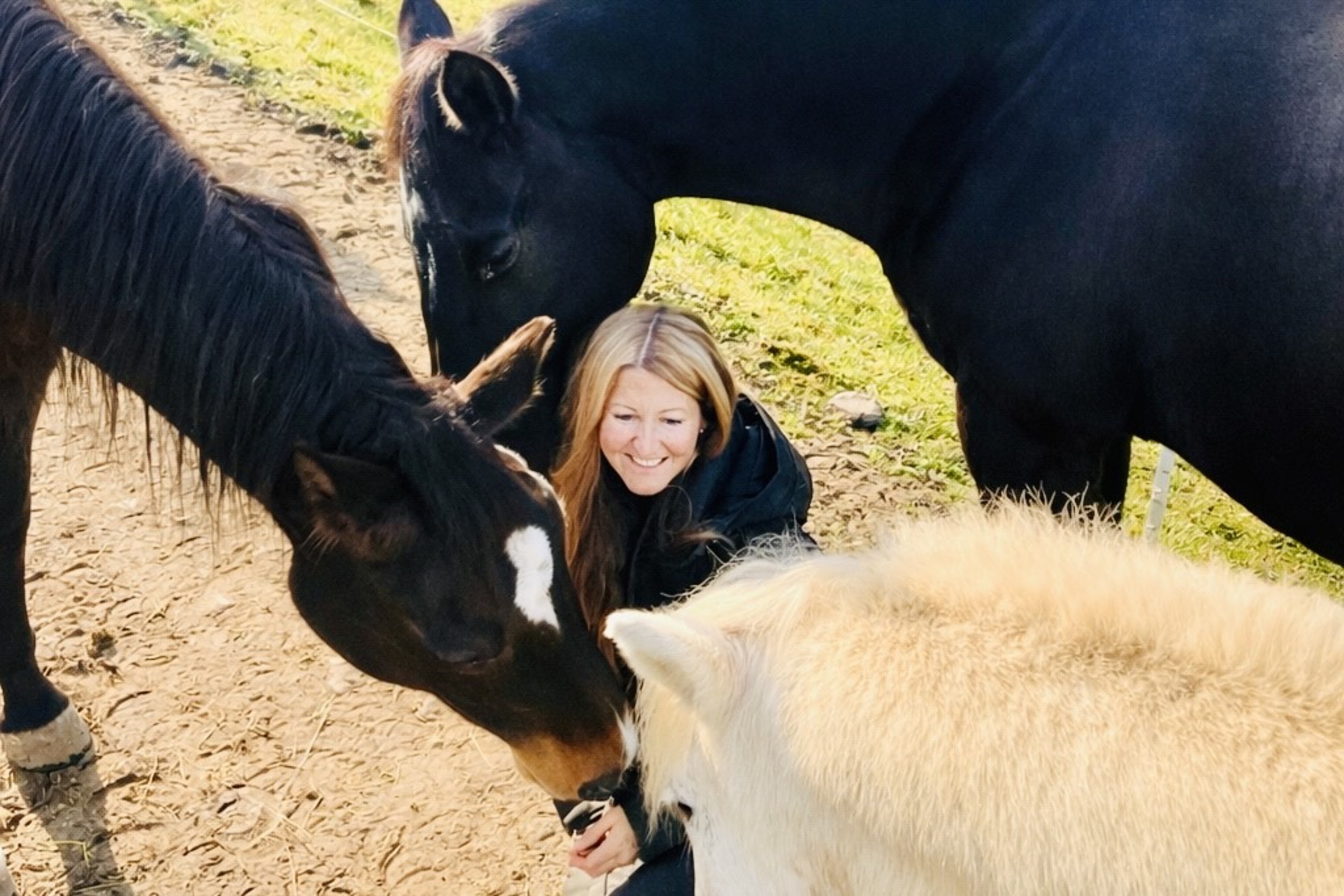
Meeting Sandra Steiner, NEOVIVA’s equine specialist, you are immediately struck by her calm presence. She’s not one to seek the spotlight, preferring to let her horses take centre stage. Yet, the moment the conversation turns to equine therapy, her expertise and heartfelt passion shine through.
Sandra’s journey to equine-assisted therapy began long before her formal psychology training. It was rooted in a childhood love of horses and the quiet sense that animals understood her in ways people never could.
“I was always the horse girl,” she says. “I helped in stables, not for the riding. I just wanted to be near the horses.”
She laughs softly as she says it, but that simple truth lies at the heart of her work today. For many NEOVIVA clients, who carry years of emotional pain and trauma, this instinctive connection with an animal often opens a remarkable doorway to change.
The horse that changed everything
Just over ten years ago, Sandra welcomed her first horse into her life: Zybersina (Zybi) a tall, powerful black mare with a demanding sporting past and a temperament that could intimidate even seasoned riders. Sandra confesses she doubted her ability to handle such a force.
“I was a fearful person back then. I didn’t think I was enough for this horse,” she says. “She had so much spirit, and I thought I wanted a quieter experience.”
Yet, after a three-month loan, letting the mare go felt even harder. That moment sparked the start of Sandra’s own transformation. The mare challenged her, helped her to confront her fears, and nurtured her self-belief. Together, they built trust, one step at a time. Now, that same mare stands as one of Sandra’s most intuitive therapy partners.
“She became my guide,” Sandra says. “She taught me to stand up for myself. And she taught me that I can go further, even when it’s hard.”
They say that you don’t choose the horse; the horse chooses you. For Sandra, this rang true from the moment her mare arrived. Their bond was no accident, and it became the foundation for the therapist Sandra would become and is today.
Why equine-assisted therapy?
Equine-assisted therapy was never part of Sandra’s original plan. She didn’t map it out in advance. Instead, it blossomed from her lifelong love of horses and her background in psychology. During an internship, she stumbled upon equine-assisted interventions, and suddenly everything clicked. It was the missing link connecting everything she cared about: people, health, animals and nature.
Sandra always wanted to help people in a meaningful way, but she knew traditional talk therapy alone didn’t reflect how she wanted to guide them. She was drawn to approaches that encouraged growth and forward movement, not just analysis of the past. Positive psychology offered that path, and the horses brought it vividly to life.
Equine-assisted therapy was the missing puzzle piece.
A horse for everyone
Sandra’s herd may be small, but each horse brings special talents. Her two main therapy horses have distinct personalities and therapeutic strengths. Zybi, the big black mare, is emotional, expressive, nurturing, sensitive and communicative. As the mother of her nearly four-year-old daughter, Zaya, the horse’s caring and protective instincts run deep. Raising a foal involves complex interactions.
Frosti, the small white gelding, is a very patient, steady and grounding presence. With nervous, easily distracted or anxious clients, he is gentle and quietly draws them back to the present moment, Sandra explains.
Sandra doesn’t follow a rigid plan, often letting intuition guide her choice of horse. She believes the horses always sense more than we can imagine.
How equine-assisted interventions support recovery
Equine-assisted therapy has a special role at NEOVIVA. It doesn’t take the place of psychotherapy or medical care. Instead, it offers clients a space to explore things that can be difficult to reach in talk therapy alone. Horses communicate without judgement or expectation, opening new pathways to insights and healing.
“Horses react directly to inner states,” says Sandra. “If someone is anxious, disconnected, angry or not fully present, the horse shows it.”
During leading exercises, the horse may stop suddenly or unexpectedly. When Sandra asks about the pause, the client often discovers they were lost in thought, internally preoccupied, worrying about a conversation, or holding back emotion. The horse quietly mirrors what is happening inside the client, without words.
“It’s not me telling them,” Sandra explains. “The horse gives feedback in a way that makes people feel safe. They don’t feel criticised.”
This gentle mirroring can spark breakthroughs far quicker than traditional coaching. Insights that might take weeks to surface in regular coaching sessions can emerge in just one or two sessions when a horse is involved. Working in this way can facilitate access to repressed or difficult-to-access emotions. Equine-assisted therapy can be particularly effective in cases of strong mistrust, inner distance, shame, or emotional blockage.
For clients recovering from addiction, this kind of work touches almost every area of healing, including:
- trust
- boundaries
- communication
- emotional regulation
- relationship dynamics
- self-awareness
- stability and resilience
- reconnecting body and mind
Since addiction is so often entwined with trauma, the horses become powerful co-regulators. They help clients slow their breathing, relax, and experience genuine connection. Many leave sessions feeling more balanced. Those who arrive with too much energy leave feeling calmer, while those who feel low discover lightness. Tears may flow, but laughter is just as common.
A safe space when talking feels like too much
For clients who already spend hours in therapy sessions each week, a quiet hour outdoors with a horse can feel like a breath of fresh air.
“Sometimes the most important thing is that they can just arrive and be,” Sandra says. “They don’t need to perform. They don’t need to be anyone. They can just exist with the horse.”
Even clients who are afraid of horses can take part. Sandra tailors each session so every person feels completely safe. Some people begin by standing at a distance, just observing the horse. Gradually, as their nervous system softens and they begin to relax, they often find themselves moving closer.
One client told her that her safe space was standing with the horses. Not talking. Not thinking. Just breathing with the animals.
When horses teach what words can’t
Sandra’s approach combines elements from psychology, in particular positive psychology, systemic work, strength-based methods, and learning and attachment theory concepts. The horse is the thread that ties it all together. Therapist, client, and horse work as a team.
The horses only cooperate voluntarily.
“My horses work with me because they trust me,” she says. “If they don’t feel safe, or if someone treats them without respect, their willingness to engage decreases. They may withdraw or limit their responses, and in those moments, therapeutic work is no longer possible.”
Safeguarding the horses is essential. If a client crosses boundaries, Sandra stops the session. These moments often reveal something meaningful about the person. It becomes material for gentle, honest reflection.
The small moments that stay with clients
Sandra recalls a woman who came to her having difficulty walking after brain surgery. After months of steady work with Sandra and the horse, she showed remarkable progress in balance and coordination. By the end, she was running over obstacles with the horse faithfully by her side.
“I think the connection between her body and mind came back,” Sandra says. “She felt more integrated and in tune with herself again.”
At NEOVIVA, clients experience equine-assisted therapy over a shorter time span, so Sandra calls her work with them an “intervention” rather than longer-term therapy, applying methods from therapy and coaching. Still, the impact can be just as strong. Many clients finish a session eager to return. Others leave with new boundaries to apply at home, or a stronger sense of self that feels more grounded and resilient.
Almost everyone forms a special bond with a therapy horse. Many of the men greet Frosti, for example, with a cheerful “bro,” a moment that never fails to make Sandra smile.
Working side by side with the NEOVIVA team
One thing Sandra loves about NEOVIVA is the interdisciplinary approach. She reviews each client’s background, goals, and therapeutic focus so she can prepare an appropriate plan. Afterwards, she provides feedback on her observations to the team so they can integrate the insights into the wider recovery programme.
“We are all working towards the same goal,” she says. “Everyone has a piece of the process. And we respect each other’s part.”
This spirit of teamwork mirrors how Sandra works with her horses. Each individual brings something unique, and together they help pave the way towards healing.
Everyone is enough as they are
Sandra shares a thought that tends to stay with people for a long time.
“For horses everyone is equal,” she says. “It doesn’t matter what professional position or social role someone has. The horses don’t see status. They don’t see your past. They only see you. And they convey the feeling that you are good enough just as you are.”
On a recovery journey marked by challenges and deep self-reflection, this unconditional acceptance has the power to truly change lives.
Perhaps this is why Sandra’s work leaves such a lasting mark. Through her calm presence, the trust of her horses, and the gentle truths they reveal, clients rediscover something simple yet profound: being themselves is enough, and feeling safe is possible again.
