

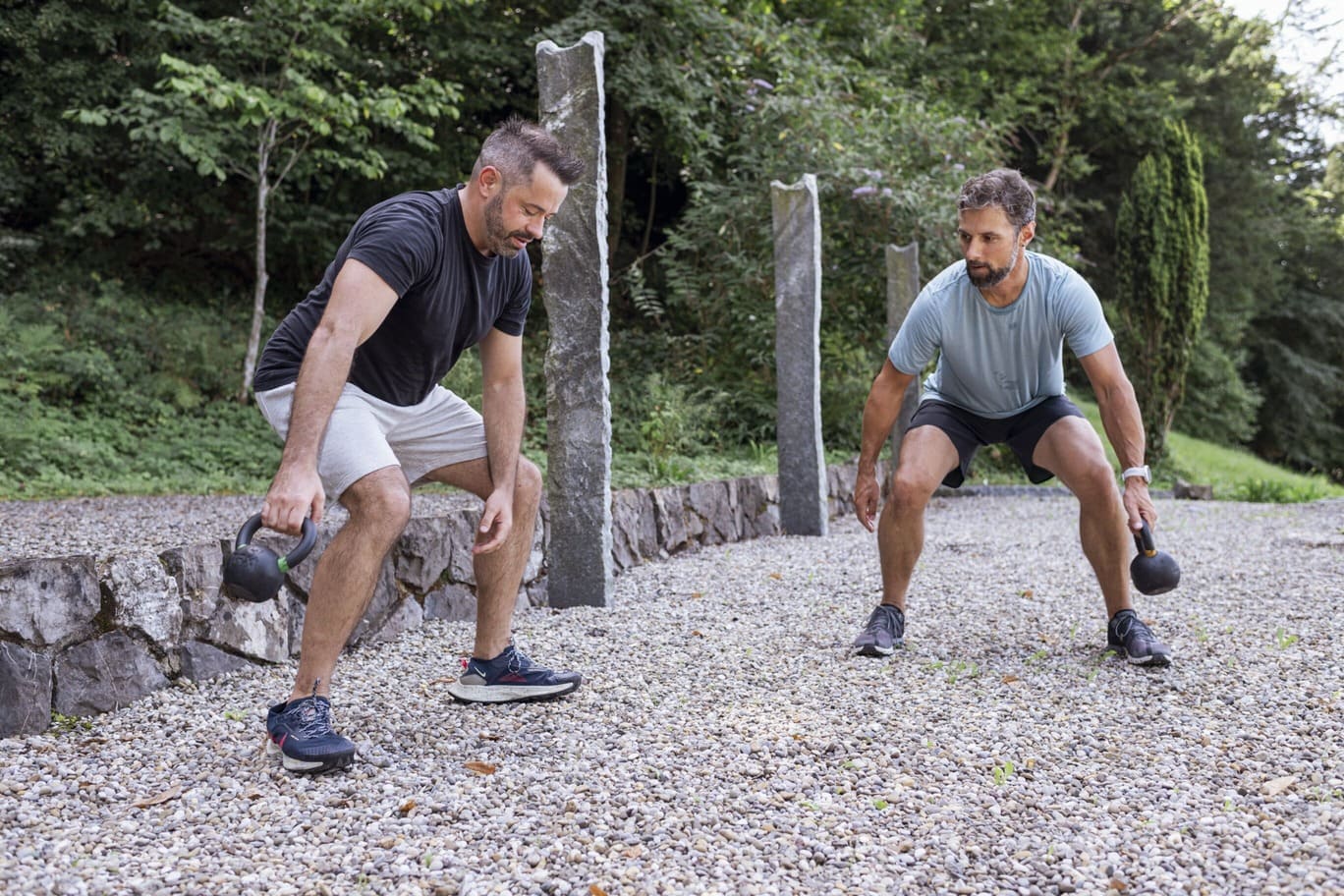
Many people starting addiction treatment arrive with their nervous system stuck in a constant state of ‘fight or flight.’ As treatment progresses, this state gradually eases. Simple activities like stretching before breakfast, swimming after a psychotherapy session, or walking before dinner become part of a new routine. Slowly, muscles feel more energised, sleep gets better, and thinking becomes clearer. The body, once a source of struggle, starts to feel like an ally.
For many in recovery, physical movement provides one of the earliest and most tangible forms of relief. Science helps explain why.
The neurobiological mechanisms of addiction
While the common perception may suggest otherwise, addiction is not a matter of willpower. It is far more complex. Addiction actually changes the brain’s systems that control reward, motivation, stress regulation and decision-making. Neuroimaging studies show that repeated drug use or addictive behaviours cause changes in several important brain circuits.[i]
At the centre of addiction lies the brain’s reward circuitry, particularly dopamine pathways within the mesolimbic area, the part of the brain responsible for processing reward, motivation, desire and pleasure. Natural rewards, such as food, social connection, or achievement and success, trigger dopamine release, encouraging mostly good habits and behaviours.
Substances such as alcohol, opioids, cocaine, and stimulants cause much bigger dopamine surges than natural rewards. With repeated use, the brain adjusts. Its receptors become less sensitive, even natural rewards feel less satisfying, and substances that once caused euphoria are needed just to feel normal. This is how addiction begins and traps someone. It is not a matter of willpower. Changes in the brain drive these maladaptive behaviours.
At the same time, the brain’s stress system, governed by the hypothalamic-pituitary-adrenal (HPA) axis, becomes more reactive. With addiction, this axis stays highly active, making people more sensitive to anxiety and emotional discomfort. Even small stressors can feel overwhelming.
Simply put, addiction disrupts three main systems:
- Reward sensitivity becomes blunted
- Stress reactivity becomes heightened
- Cognitive control becomes impaired
These changes make early recovery particularly challenging. Individuals are not only trying to change their behaviour but are also working against altered neural circuitry. It means simultaneously managing intense craving, emotional volatility, low mood, and impaired cognitive control.
The good news is that the brain can change and adapt. This process is known as neuroplasticity. With repeated positive experiences, the brain’s pathways can reorganise and regain balance. But it takes time.
This is where exercise becomes especially relevant.
How exercise helps restore the addicted brain
Since addiction disrupts the reward, stress, and self-control systems, recovery needs experiences that restore balance to these areas.
Physical exercise does precisely that.
A review of exercise programmes in addiction treatment found improvements in abstinence and fewer cravings across the majority of studies examined.
Exercise helps in three main ways:
Restoring reward sensitivity
Addictive substances overstimulate dopamine pathways, making receptors less sensitive and increasing cravings. Moderate aerobic exercise activates these pathways in a healthier, more balanced way.
When you exercise, your body releases dopamine and endorphins at healthy levels. This regular stimulation helps reset the brain’s reward system instead of overwhelming it. Research suggests that exercise can help rebalance the brain changes linked to addiction.[iii]
Over time, with regular exercise, natural rewards start to feel more meaningful again, and cravings become less intense.
Regulating the stress response
Addiction makes the body’s stress systems more sensitive, leading to bigger emotional ups and downs in early recovery.
Exercise creates a controlled form of physical stress. At first, heart rate and cortisol levels go up. But with regular exercise, the body gets better at handling and recovering from stress. This helps lower anxiety, improves nervous system balance, and builds resilience. Essentially, exercise helps the body relearn how to manage stress.
When people can manage stress better, they are more able to handle discomfort without turning to alcohol, drugs, or harmful behaviours for relief.
Strengthening executive control
Using substances weakens the prefrontal cortex – the part of the brain known as the ‘executive centre’. This frontal lobe of the brain manages high-order thinking, risk assessment, and helps with focus. When this area is disrupted by addiction, it reduces impulse control and makes it harder to plan for the long term.
Regular, structured exercise seems to help the prefrontal cortex function more effectively.[iv] Studies show improvements in attention, self-control, and goal setting. Physical activity encourages the brain to form new connections that support emotional processing and decision-making.
Exercise also helps people practice self-control. Each session takes planning, consistency, and the ability to handle short-term discomfort for long-term gain. In this way, movement becomes a real-life way to practise recovery skills.
Exercise is uniquely effective because it engages reward, stress and cognitive systems simultaneously. It does not merely support recovery externally; it contributes to reshaping the biological foundations of addiction.
“When we integrate movement into recovery, we are not simply encouraging lifestyle change. We are deliberately engaging the body’s ability for neuroplasticity. Exercise stimulates the very systems that addiction has destabilised, and over time, it helps rebuild regulatory capacity.” Dr. med. Andrei Khomenko (Chief Medical Officer)
Are certain types of exercise better than others?
Research shows that different types of physical activity offer distinct benefits, but there isn’t a single “best” choice.
A large review comparing aerobic exercise, resistance training, and mind-body practices for rehabilitation in drug-dependent individuals found that moderate aerobic exercise, such as brisk walking, jogging, cycling or swimming, consistently leads to the biggest improvements in mood, anxiety, and cravings.[v] This is probably because aerobic activity directly affects the cardiovascular and dopamine systems.
Strength training offers its own benefits, especially for thinking skills, confidence, and setting and reaching goals.
Mind-body practices like yoga help with stress management, emotional balance, and body awareness, which can be especially useful early in recovery.
What matters most is sticking with it. The best exercise is one that a person can engage in and do regularly. When physical activity matches someone’s abilities and preferences, they are more likely to keep it up. It is the consistency of physical activity that leads to real changes in the brain and behaviour.
“There’s no single best workout for recovery. Everyone is different. What matters most is engagement and sustainability. We tailor our programmes to ensure each individual can engage in exercise that they will return to again and again.
“Personalised medicine is more than a slogan or a fashionable concept. It represents a fundamental shift in how we understand treatment and recovery. Every client brings a unique biological, psychological, and social background, and effective care must reflect this complexity.” Dr. med. Andrei Khomenko (Chief Medical Officer)
The benefits of exercising in groups and building community
While exercise helps regulate the brain, doing it in a group adds something extra: social connection.
Addiction often shrinks social circles, leading to isolation, broken relationships, and shame. Recovery means reconnecting with the self and with others.
Group-based exercise helps people to regulate together. Breathing synchronises, pace becomes similar, effort is mirrored, building a sense of camaraderie and belonging. Research shows that in recovery, exercising together can strengthen bonds and reduce stigma, especially in welcoming communities.[vi]
Unlike traditional group therapy, exercise doesn’t require people to open up straight away. There’s no pressure to talk or share personal details. Instead, connection grows through working out together.
Group activities also add structure and accountability. Having set times, workout partners, and shared goals helps keep people on track, even when motivation fluctuates. Over time, people may start to see themselves as capable and committed, not just defined by addiction.
“Recovery rarely succeeds in isolation. Group-based exercise builds trust through shared effort and strengthens the therapeutic process.” Dr. phil. Mayte Parada (Clinical Lead)
Physical movement restores regulation. Community brings back connection. Together, they strengthen the foundation for lasting recovery.
Exercise as part of the therapeutic environment
Addiction disrupts reward pathways, heightens stress, and impairs cognitive control. A big part of recovery is restoring regulatory balance.
“Recovery itself is an active process. Similar to the principles of neuroplasticity, the brain changes in response to experience and engagement. In this sense, recovery is a choice that must be practised and supported – use it or lose it. When clients are empowered to actively participate in their healing process, the likelihood of long-lasting positive outcomes increases significantly.” Dr. med. Andrei Khomenko (Chief Medical Officer)
Exercise offers a practical, evidence-based way to support that process. It engages the neural systems altered by addiction in a stabilising and restorative manner. Through consistent participation, physical activity recalibrates reward sensitivity, strengthens stress resilience, and reinforces healthy executive function.
“We view exercise as part of the therapeutic environment. When integrated thoughtfully, tailored to the individual, it enhances the effectiveness of psychotherapy and medical care.” Dr. phil. Mayte Parada (Clinical Lead)
Recovery involves restoring balance.
“A truly individualised treatment approach therefore goes beyond symptom reduction. It integrates biological factors, psychological processes, and social context into a holistic framework aimed at meaningful recovery.” Dr. med. Andrei Khomenko (Chief Medical Officer)
When applied consistently, physical exercise can play a meaningful role in that restoration. As recovery is an ongoing process, finding forms of exercise that are enjoyable and promote sustained engagement with physical activity can support continued progress over time.
_________________________________________________________________________________________________
[i] Xinwen Wen, Lirong Yue, Zhe Du, Linling Li, Yuanqiang Zhu, Dahua Yu, Kai Yuan, Implications of neuroimaging findings in addiction, Psychoradiology, Volume 3, 2023, kkad006, https://doi.org/10.1093/psyrad/kkad006.
[ii] Patterson MS, Spadine MN, Graves Boswell T, Prochnow T, Amo C, Francis AN, Russell AM, Heinrich KM. Exercise in the Treatment of Addiction: A Systematic Literature Review. Health Educ Behav. 2022 Apr 29:10901981221090155. doi: 10.1177/10901981221090155. Epub ahead of print. PMID: 35484950.
[iii] Abdullah, M., Huang, L. C., Lin, S. H., & Yang, Y. K. (2022). Dopaminergic and glutamatergic biomarkers disruption in addiction and regulation by exercise: a mini review. Biomarkers, 27(4), 306–318. https://doi.org/10.1080/1354750X.2022.2049367
[iv] Chen, J., Wang, X., Zhang, X., Xiao, W., Kabachkova, A., & Tan, Y. (2025). Effects of exercise on executive function in individuals with drug addiction: A systematic review and three-level meta-analysis. Frontiers in Sports and Active Living, 7, 1646327. https://doi.org/10.3389/fspor.2025.1646327
[v] Montón-Martínez, R.; Castellano-Galvañ, I.; Roldán, A.; Javaloyes, A.; Peña-González, I.; Sarabia, J.M.; Pastor, D.; Moya-Ramón, M. Effects of Physical Exercise on Substance Use Disorder: A Comprehensive Review. Appl. Sci. 2025, 15, 1481. https://doi.org/10.3390/app15031481
[vi] Heinrich, Katie M. PhD, FACSM1; Patterson, Megan S. PhD, MPH2; Collinson, Beth PhD, MRes1; Streetman, Aspen E. PhD3. Exercise as Medicine for Addiction Recovery. Current Sports Medicine Reports 24(8):p 235-239, August 2025. | DOI: 10.1249/JSR.0000000000001271
